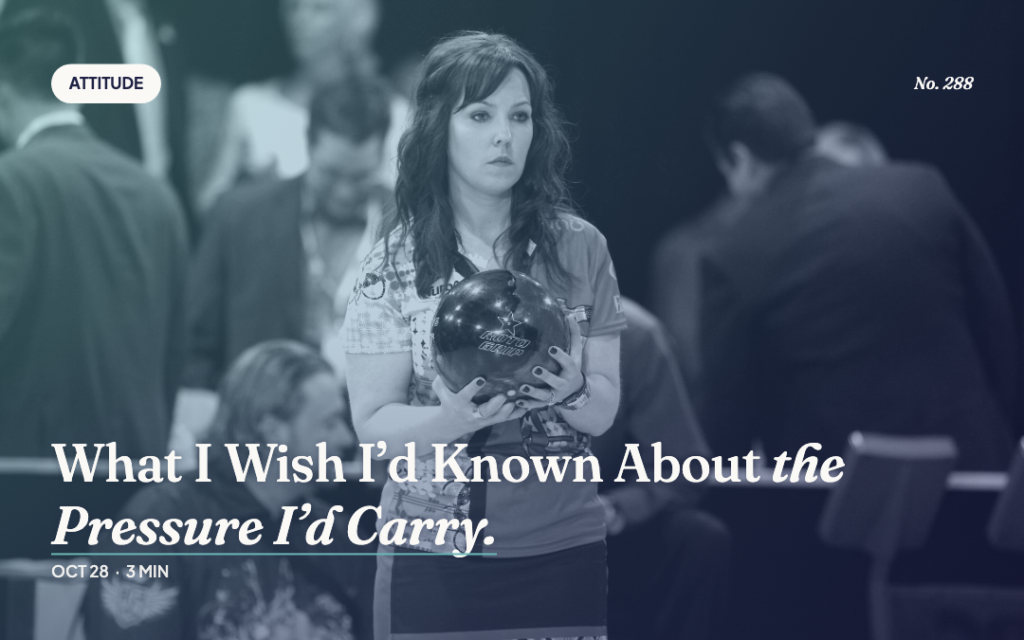
It felt like I was waiting forever.
But that’s what happens when you’re the number one seed. I felt like the tournament was already mine since I dominated all week long. I led qualifying, and no one beat me in double elimination.
I stepped onto the live TV pair and I made every single mistake in the book.
No one gave me what I needed for that moment. Nobody ever taught me what to do in that frame.
Here’s the kind of pressure nobody warns you about. When you’re the underdog, no one is looking at you. There’s no pressure, and you are free to be who you are. It’s so much easier to succeed. But once you emerge from the shadows, everyone is watching. And now you’re carrying the weight of everyone’s expectations on your shoulders.
That week, I was out of the shadows. I was the one everyone expected to win. On live TV.
There’s actually research on this. Back in 1985, a group of psychologists found that when people privately believed they would do well, they performed better. But when an audience expected them to do well, they performed worse. Same task. The only difference was whose expectations they were carrying.
Whaaat?
Sometimes I carried that weight well. But most of the time, I did not. I thought everyone saw my every mistake, and I thought everyone judged me for it. On that TV pair, I was sure every single person watching saw every single mistake.
That’s the part I wish I’d known back then. They weren’t watching nearly as closely as I thought. And they weren’t judging me nearly as hard as I thought, either.
Psychologists call this the spotlight effect. In one study, college students had to walk into a room full of other students wearing a Barry Manilow t-shirt. (Yes, really.) Afterward, the students wearing the shirt guessed that about half the room noticed it. Fewer than a quarter actually did. Another study looked at people who failed at something in front of others. They were sure the people watching would think a lot less of them. The people watching judged them far less harshly than they feared.
We make up stories in our minds about what people are thinking of us. And those stories are far worse than the reality of it all.
So what helped me get through it? Honestly, it wasn’t one person. It was time, and wisdom later on. I don’t think I ever really got a good hold on it when I was in the moment. But when I was able to reflect back, I had clearer vision.
There’s research on that, too. Psychologist Ethan Kross found that when we step back and look at a hard moment the way an outsider would, we see it more clearly and stop replaying it over and over. That’s what time did for me. But it’s also a skill, which means you can practice it now. You don’t have to wait years for it like I did.
So if you’re feeling crushed by pressure right now, here’s what I’d tell you.
It always feels worse than it is.
That’s what I wish someone had told me before I stepped onto that TV pair.
What story are you telling yourself about the people watching you?
If the weight of everyone’s expectations is sitting heavy on your shoulders, that’s exactly the kind of thing we work on in 12 Frames to a Stronger Mental Game. One-on-one, built around you.